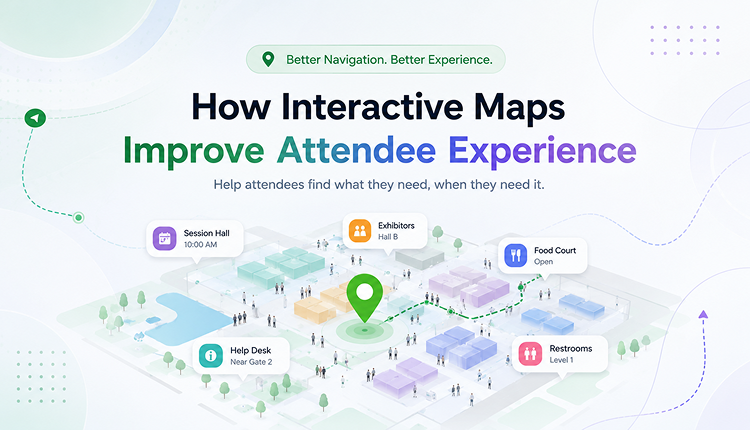
How Interactive Maps Improve Attendee Experience at Events
Discover how interactive maps help event attendees navigate venues, find key locations, access real-time information, and enjoy a better event experience.
Introduction
Attendee experience has become one of the most critical factors in determining the absolute success of any modern event. Whether it's a high-stakes business conference, a bustling trade show exhibition, a sprawling multi-day music festival, a massive university orientation, a high-energy sports tournament, or a public exposition, visitors expect a seamless, engaging, and entirely stress-free experience from the moment they arrive to their final departure.
One of the most persistent hurdles attendees face is venue navigation. Expansive floor plans, multiple split activity zones, sudden schedule adjustments, and heavily crowded environments can make it deeply overwhelming for visitors to find what they are looking for.
This is precisely where interactive maps are completely transforming the landscape of modern events.
Unlike traditional static PDF maps and printed paper booklets, live interactive maps provide dynamic real-time information, intelligent searchable locations, friction-free QR code access, and mobile-first navigation layouts. These digital features empower attendees to move confidently throughout any venue while drastically boosting their on-site engagement and overall event satisfaction.
In this comprehensive guide, we'll dive deep into exactly how interactive maps improve attendee experiences and why they have officially become an essential tool for successful event management in 2026.
What Are Interactive Event Maps?
Interactive event maps are cloud-hosted, responsive digital solutions that allow attendees to dynamically engage with real-time venue information through their personal smartphones, tablets, or computers.
Unlike flat, analog, or static maps, interactive event maps enable users to:
-
Instantly search for physical locations, room names, and booth numbers
-
Plot out optimized walking routes across complex layouts
-
View live, updated schedules mapped directly to specific rooms
-
Locate distinct exhibitors, product demonstrations, and corporate sponsors
-
Find essential amenities like restrooms, water stations, and help desks
-
Access background event information, external links, and media pop-ups
-
Receive instantaneous logistical updates and security notifications in real time
These robust, intuitive capabilities merge spatial wayfinding with digital convenience, creating a significantly higher-tier experience for every visitor.
Why Attendee Experience Matters
In a digital-first world, today's event attendees demand absolute convenience. People rely heavily on digital mapping applications every single day to confidently navigate city grids, multi-level shopping centers, complex international airports, and complex public transportation systems. Naturally, they expect that exact same fluid level of convenience when paying to attend a premium event.
When an event relies on outdated mapping methods, poor venue navigation quickly leads to the following:
-
Intense visitor frustration and mental fatigue
-
Missed keynote presentations, workshops, or networking meetups
-
Lower overall crowd engagement with exhibitors and vendors
-
An influx of negative social media feedback and poor review scores
-
Dramatically reduced event retention and registration satisfaction
Integrating interactive mapping solutions directly solves these organizational and spatial challenges before they ever impact the attendee.
How Interactive Maps Maximize the Attendee Experience
1. Simplified Venue Navigation
The most immediate benefit of an interactive map is completely stripping away the confusion of physical wayfinding. Instead of wandering blindly or trying to decipher a dense print layout, attendees can use an embedded search bar to instantly pinpoint exactly what they need, including:
-
Registration desks and check-in counters
-
Breakout session rooms and speaker halls
-
Individual exhibitor booths and vendor pavilions
-
Sprawling food courts and custom concession stands
-
Restrooms, first-aid areas, and information desks
-
Designated parking structures and rideshare drop-off points
2. Instant Access via QR Codes
Modern events are aggressively deploying QR code maps to bridge the physical venue with the digital world. Organizers place high-contrast QR codes on banners, badges, entry doorways, and floor signs.
Visitors simply point their phone camera at the code to open the full map. This offers immense benefits:
The App-Free Edge: Because the digital map renders directly inside the phone's native mobile browser, attendees don't have to deal with the friction, data usage, or time delay of downloading a dedicated application from an app store. Access is instantaneous.
3. Real-Time Cloud Updates
Live events are highly volatile ecosystems that frequently experience structural or timeline shifts throughout the day. Common examples include sudden speaker room swaps, session time extensions, unexpected vendor relocations, or emergency corridor adjustments.
Traditional printed handouts become instantly incorrect when these changes occur, misleading the crowd. Interactive maps update instantly via a centralized cloud backend, ensuring that every single attendee is looking at accurate, live information.
4. Reduced Confusion and Stress
Getting thoroughly lost in a packed, noisy convention center or a muddy outdoor festival field can completely ruin a visitor's day. Interactive maps completely erase this anxiety by offering clear directional assistance, searchable nodes, and prominent visual landmarks right on the user's screen. Attendees spend less time navigating logistics and significantly more time enjoying the event's core programming.
5. Seamless Event Discovery
Statistically, a massive portion of event attendees only ever see a tiny fraction of a venue because they simply do not know what else exists around them. Interactive maps naturally encourage deep venue exploration by explicitly highlighting and tiering points of interest.
Attendees can pan around the digital layout to actively discover niche exhibitors, prime corporate sponsors, hidden attractions, exclusive networking lounges, and interactive entertainment zones, maximizing the ROI of their ticket.
6. Advanced Accessibility Support
Inclusivity has rightfully become a top operational priority for modern event planners. Static paper maps are extremely limited in detailing accessibility options.
Interactive maps can feature toggle filters that explicitly highlight wheelchair-accessible routes, ADA elevators, flat walking ramps, accessible parking spaces, and dedicated accessible restrooms, ensuring that all diverse user groups can navigate the space with absolute dignity and ease.
7. Mobile-First Optimization
Since attendees heavily depend on their smartphones to scan badges, take notes, and network, interactive maps are built from the ground up specifically for mobile web viewports. Users can seamlessly access schedules, search specific vendors, plot pathways, and look up nearby amenities simultaneously within a singular, fast-loading, lightweight web interface.
Interactive Maps vs. Traditional Event Maps
| Feature | Live Interactive Maps | Static PDF Maps | Traditional Printed Guides |
| Real-Time Updates | Yes, instant cloud sync | No, requires new file upload | No, completely unchangeable |
| Search Functionality | Yes, instant keyword search | No, manual eye scanning only | No, must flip through pages |
| QR Code Access | Yes, launches instantly in web browser | Limited, downloads a heavy file | No, completely analog format |
| Mobile Optimization | Excellent responsive layout | Poor clunky pinch-to-zoom | None, physical paper material |
| Navigation Assistance | Yes, step-by-step route mapping | No, static visual overview only | No, static drawing layout |
| Accessibility Support | Advanced, dedicated route filters | Basic, limited icon markings | Basic, tiny printed symbols |
| Visitor Analytics | Yes, tracks popular paths & clicks | No, zero user insights captured | No, zero tracking capability |
| Environmental Impact | None, completely paperless | None, fully digital file format | High, massive paper trash waste |
| User Experience | Excellent, modern, and personal | Average, cumbersome on phones | Limited, easily lost or damaged |
Key Benefits for Event Organizers
While the attendee reaps the direct rewards of smooth navigation on the ground, event organizers gain incredible backend strategic advantages:
-
Fewer On-Site Support Requests: Because attendees can look up directories and facilities independently on their phones, support counters, help desks, and security guards experience a massive drop in basic navigation questions.
-
Optimized Crowd Management: Flow algorithms and clear maps ensure that crowds split efficiently across multiple pathways, eliminating dangerous human bottlenecks in main corridors.
-
Premium Sponsor Monetization: Organizers can upsell premium spatial packages to top-tier event sponsors, offering them custom branded map pins, clickable pop-up ad banners, and highlighted profile links directly inside the navigation tool.
-
Enhanced Professional Image: Utilizing high-tech digital wayfinding instantly makes an event feel premium, forward-thinking, organized, and meticulously executed.
-
Invaluable Behavioral Analytics: The mapping backend securely logs aggregated user interactions. Organizers can clearly see what the most searched booths were, which paths were viewed most, and what facilities saw the highest traffic, yielding data to mathematically optimize next year's floor plan.
How emapX Live Revolutionizes Event Wayfinding
Platforms like emapX - Live Custom Maps are pioneering the movement away from rigid, legacy event mapping styles. emapX Live equips organizers with an incredibly user-friendly yet powerful toolset to build beautiful, bespoke interactive digital environments tailored for conferences, music festivals, stadiums, university open houses, and urban districts.
By using emapX Live, management teams can completely discard old-school, single-use PDF designs and seamlessly deploy responsive digital layouts embedded with smart search functionalities, white-label branding controls, rapid on-site QR code accessibility, and monetization channels for event exhibitors. It is the premier way to operate a highly efficient event while executing a modern digital presence that visitors appreciate.
The Future of Event Navigation
As technology moves deeper through 2026, the attendee experience is becoming intrinsically linked with creative digital architecture. Interactive maps are serving as the mandatory framework for highly anticipated incoming tech innovations:
-
Indoor Positioning Systems (IPS): Integrating map software with Bluetooth Low Energy (BLE) beacons to provide real-time "blue-dot" turn-by-turn walking navigation inside massive, multi-level convention centers.
-
Augmented Reality (AR) Pathfinding: Allowing attendees to scan an indoor QR code and follow glowing, virtual directional arrows overlaid onto the real world through their phone screens.
-
AI-Powered Localized Recommendations: Intelligent map assistants that automatically analyze an attendee's digital ticket or industry interests and actively highlight specific booths or networking hubs they should visit next.
-
Live Congestion Routing: Dynamic alerts that gently notify users when a specific entrance, food line, or stadium exit is heavily congested, offering alternative walking paths across the venue floor plan.
Frequently Asked Questions
How exactly do interactive maps improve the overall attendee experience?
Interactive maps remove the cognitive friction of getting lost. They provide immediate keyword searching, real-time schedule tracking, and mobile-responsive layouts so visitors can navigate crowded spaces with total confidence and zero stress.
Do attendees need to download a heavy application to use an interactive map?
No. Advanced mapping solutions allow organizers to host the full interactive map via a standard web URL. Attendees simply scan an on-site QR code, and the entire map interface launches instantly within their phone's native mobile browser.
Can interactive maps handle sudden schedule or room changes?
Absolutely. Administrators can log into a cloud dashboard, adjust text labels, shift booth assignments, or highlight an arena closure, and the changes publish instantly to every single device viewing the map.
Are interactive maps a viable replacement for physical printed guides?
Yes. They completely eliminate recurring print fees, wipe out paper material waste, offer advanced search capabilities that paper cannot match, and provide organizers with invaluable data analytics on attendee movement.
What kind of data can event organizers track through these maps?
Organizers can monitor aggregated, anonymous trends such as peak scan times, the most frequently typed search queries, popular booth clicks, and heavily viewed structural zones to measure true visitor interest.
Conclusion
Creating a world-class, frictionless attendee experience is no longer an optional luxury; it has become essential for the long-term growth and success of any modern event.
Interactive maps play an undeniable role in this shift by helping attendees navigate intricate spaces with ease, access live organizational data instantly, discover hidden venue content independently, and enjoy a remarkably smoother overall journey from arrival to departure. From the unmatched convenience of app-free QR code access and real-time cloud updates to inclusive accessibility mapping and responsive mobile design, interactive maps provide a decisive competitive edge over analog alternatives.
As consumer expectations continue to climb throughout 2026, forward-thinking event organizers who step away from static PDFs and proactively embrace live interactive mapping technology will be best positioned to deliver memorable, safe, highly engaging, and financially successful events.
What is the layout of your upcoming event space, and what specific navigation challenges do your attendees typically face during peak crowd hours?
